The Cost of Being Wrong Has Normalised: Imbalance Prices Return to Earth
Published on 16 July 2026
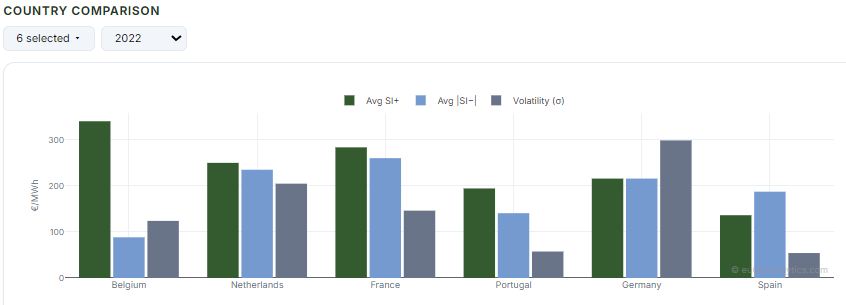
The price a market participant pays for being short when the system is short, SI+, has come back to earth. In 2022 that cost averaged 340 €/MWh in Belgium, 283 in France and 216 in Germany. So far in 2026 it stands at 120, 70 and 99. The energy crisis did not just inflate wholesale prices. It inflated the penalty for getting your forecast wrong, and that penalty has now unwound.
2022 priced imbalance like an emergency, because it was one
SI+ is what you pay when you are short of energy at the same moment the system is. In 2022 that coincidence was priced like an emergency: 340 €/MWh on average in Belgium, 283 in France, 216 in Germany. Behind those averages sat scarce French nuclear capacity, record gas prices setting the marginal unit, and balancing markets that were still largely national. Every forecast error was settled against a system with no slack.
Data sources: Elia (BE), Netztransparenz (DE), ESIOS/REE (ES), ENTSO-E (NL, FR, PT), processed by euGreenalytics
France shows the unwind most cleanly: the crisis premium was the story
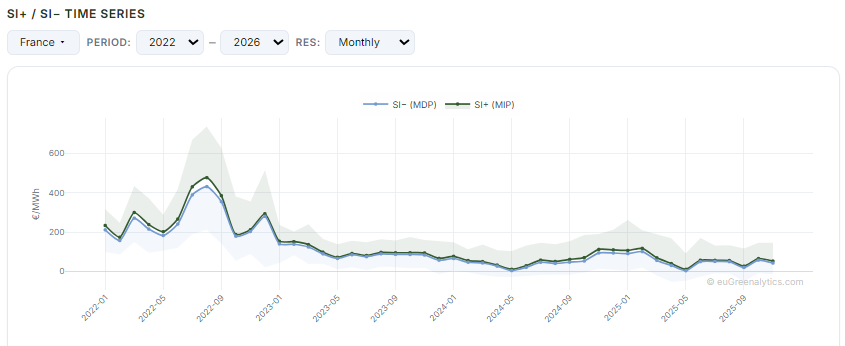
France's monthly SI+ has fallen from an average of 283 €/MWh in 2022 to 70 so far in 2026, a drop of 75%. The trajectory tracks the recovery of the nuclear fleet: as availability returned, the scarcity premium embedded in every balancing settlement drained away. What is left in 2026 looks like a structurally normal balancing cost, not a discounted crisis. The 2022 number was the anomaly, and the time series makes that visible month by month.
Data sources: Elia (BE), Netztransparenz (DE), ESIOS/REE (ES), ENTSO-E (NL, FR, PT), processed by euGreenalytics
The 2026 map rewards flexibility and integration, not size
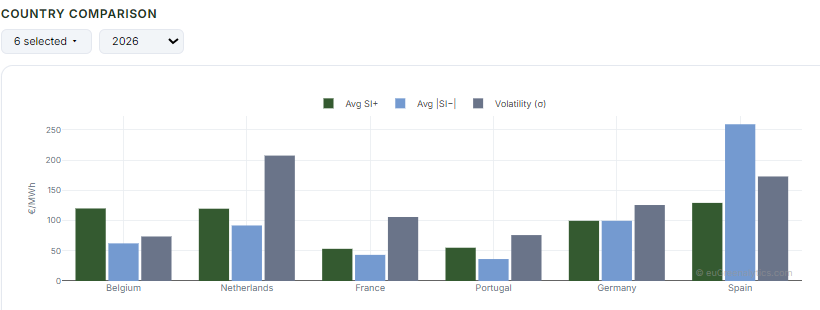
So far in 2026 being short costs 120 €/MWh in Belgium, 99 in Germany and 70 in France, with Portugal the cheapest of the six markets at 55. The ordering is telling: the cheapest balancing is not in the biggest market but where surplus renewables and system slack meet. And the compression is not only a story of fuel costs falling. Cross-border balancing platforms now let the cheapest reserves clear across borders, which files down the extreme settlements that used to define a bad half hour. A short position still costs money. It no longer costs a crisis.
Data sources: Elia (BE), Netztransparenz (DE), ESIOS/REE (ES), ENTSO-E (NL, FR, PT), processed by euGreenalytics
Key Takeaways
- The average cost of being short (SI+) has collapsed since the crisis: Belgium 340 to 120 €/MWh, France 283 to 70, Germany 216 to 99, comparing 2022 with 2026 so far.
- France is the cleanest unwind: SI+ down 75% from 2022 to 2026 as the nuclear fleet recovered and the scarcity premium drained out of balancing settlements.
- Portugal is now the cheapest of the six markets to be short in, at 55 €/MWh on average in 2026.
- The compression is structural as well as cyclical: cross-border balancing platforms now clear the cheapest reserves across borders, trimming the extremes that defined 2022.
Data Disclaimer: Market data sourced from the ENTSO-E Transparency Platform (A44), OMIE and Energy Charts, processed independently by euGreenalytics. Provided for informational purposes only, not investment, trading, or commercial energy advice. Historical data does not predict future market behaviour. euGreenalytics is not affiliated with or endorsed by ENTSO-E, OMIE, Energy Charts, or any other data source referenced. Terms of Use · Data Sources